

Changing Communities[Societies] and behaviors by communication[ Advancing Health & Development].
HEALTH CONSULTING International
Dr Thompson Ntuba Akwo
International Speaker[Communicator]/Consultant
.jpg)
Registered in the state of Texas [San Antonio]
FN20130473262
Bank of America. Tel, SAN ANTONIO.
WASHINGTON DC,
PO BOX 17161 HOUSTON TEXAS USA 77722
TEL. 7372352378
Global goals : Global health .
BY DR AKWO THOMPSON NTUBA
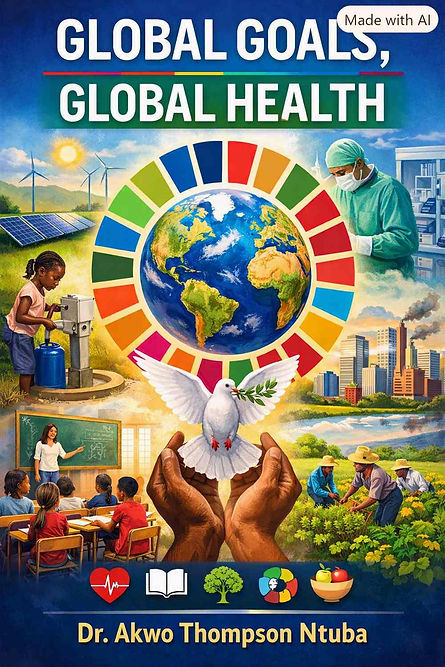

GLOBAL GOALS, GLOBAL HEALTH By Dr. Akwo Thompson Ntuba**
**📘 1. TABLE OF CONTENTS
PART I — FOUNDATIONS OF GLOBAL HEALTH & DEVELOPMENT
-
The Architecture of Global Health
-
Poverty, Inequality, and the SEEDs of Health
-
The Evolution of Global Development: From MDGs to SDGs
-
Health as the Backbone of National Development
-
Governance, Justice, and Strong Institutions (SDG 16)
PART II — DR. NTUBA’S GLOBAL HEALTH JOURNEY
6 Three Decades Across Continents: A Practitioner’s Chronicle
7 Public Health Communication as a Tool for Social Change
8 HealthNDevelopment Magazine: Documenting Global Progress
9 Global Health Diplomacy: Johns Hopkins, WHO, USAID, World Bank
10 Partnerships for the Goals (SDG 17)
PART III — SYSTEMS THAT SHAPE HEALTH
11 Socio‑Economic & Environmental Determinants (SEEDs)
12 Energy, Climate, and Environmental Justice (SDGs 7, 13, 15)
13 Education, Gender, and Human Development (SDGs 4 & 5)
14 Food Security, Nutrition, and Agricultural Health (SDG 2)
15 Clean Water, Sanitation, and WASH (SDG 6)
PART IV — GOVERNANCE, CITIES, AND COMMUNITIES
16 Healthy Cities and Urban Development
17 Transportation, Housing, and Built Environments
18 Macro‑Economics, Health Finance, and Development Funding
19 Governance Correction and Institutional Restoration
20 Civic Leadership, Human Rights, and Community Empowerment
PART V — HUMANITARIAN WORK & GLOBAL SOLIDARITY
21 Humanitarian Aid and Disaster Response
22 Refugee Health, Rights, and Post‑Crisis Reconstruction
23 Ebola, COVID‑19, and Global Epidemic Preparedness
24 Globalization, Trade, and Foreign Policy in Health
25 The Future of Global Health: Technology, Diplomacy, and Equity
PART VI — LEGACY, LEADERSHIP & THE GLOBAL FUTURE
26 A Life in Service: The Global Physician‑Communicator
27 Building Institutions That Protect Human Dignity
28 The Moral Architecture of Development
29 The Next Generation of Global Leaders
30 A Vision for 2050: Peace, Partnerships, and Planetary Health
**PREFACE
GLOBAL GOALS, GLOBAL HEALTH
By Dr. Akwo Thompson Ntuba**
There are moments in a life of service when the world reveals itself not as a collection of nations, but as a single human family—interdependent, fragile, resilient, and bound together by the universal desire to live with dignity. My journey through global health and development has been shaped by these moments. They occurred in crowded clinics and quiet policy rooms, in refugee settlements and university halls, in city councils and global summits. They occurred wherever humanity gathered to confront its greatest challenges.
For nearly three decades, I have walked the corridors where decisions about health, justice, and development are made. I have stood with communities where those decisions are felt. I have witnessed how poverty steals potential, how weak institutions deepen suffering, and how injustice fractures the very foundation of society. Yet I have also seen how hope rises—through education, through clean water, through strong governance, through partnerships that honor human dignity.
This book emerges from that lived experience.
It is shaped by the lessons learned while documenting global development through Health & Development Magazine USA. It is informed by the socio‑economic and environmental determinants of health—the SEEDs—that define whether families thrive or struggle. It is strengthened by years of work with global institutions: Johns Hopkins, WHO, USAID, the World Bank, civic governments, humanitarian networks, and development partners across continents. It is inspired by the Sustainable Development Goals, which reflect the truth that health is not a sector but a system—woven through education, gender equality, energy, climate, justice, and partnerships.
I have seen how a clean energy grid keeps a rural clinic alive at night. How a repaired road becomes a lifeline for a pregnant woman seeking care. How a classroom transforms the health of a generation. How strong institutions protect the vulnerable and restore trust. How peace is the greatest public‑health intervention of all.
These are not theories. They are realities witnessed in the field, documented in my work, and carried into every chapter of this book.
GLOBAL GOALS, GLOBAL HEALTH is not simply an academic text. It is a chronicle of a global journey—a journey of communication, governance, humanitarian response, and development leadership. It is a reflection on the interconnectedness of our world and a call to action for those who understand that health is the foundation of human progress.
This book is written for leaders, practitioners, students, policymakers, and citizens who believe that development must be just, inclusive, and sustainable. It is written for those who recognize that the future of global health depends on our ability to build strong institutions, empower communities, and protect the planet we share.
Above all, it is written as a legacy document—an offering to the next generation of global leaders who will inherit the responsibility of shaping a healthier, fairer, and more peaceful world.
May these pages serve as a guide, a witness, and a reminder that global health is not a distant ideal. It is the daily work of humanity. It is the architecture of our shared future.
— Dr. Akwo Thompson Ntuba Global Physician‑Communicator HealthConsulting International, Health & Development Magazine USA
**FORWARD
GLOBAL GOALS, GLOBAL HEALTH By Dr. Akwo Thompson Ntuba**
The world today stands at a defining crossroads. Nations are confronted by crises that transcend borders—epidemics, climate shocks, governance failures, humanitarian emergencies, and widening inequalities. Yet within these challenges lies an extraordinary opportunity: the chance to build a new architecture of global health and development rooted in justice, dignity, and shared responsibility.
For more than three decades, my work has taken me across continents, institutions, and communities. I have witnessed the struggles of families navigating poverty, the resilience of cities rebuilding after epidemics, the determination of leaders striving to strengthen governance, and the quiet heroism of health workers who carry the weight of humanity on their shoulders. These experiences have shaped my understanding of global health not as a technical field, but as the moral foundation of development itself.
Health is the first pillar of national progress. Governance is the second. Human dignity is the third.
When these pillars stand together, societies rise. When they weaken, nations falter.
This book, GLOBAL GOALS, GLOBAL HEALTH, emerges from that lived reality. It is a synthesis of the socio‑economic and environmental determinants—the SEEDs—that define human wellbeing. It is a reflection on the Sustainable Development Goals, which form the global blueprint for justice, peace, and prosperity. It is a chronicle of the intersections between health, governance, energy, climate, education, gender equality, humanitarian response, and institutional strength.
My work with global institutions—from Johns Hopkins to WHO, USAID, the World Bank, civic governments, and humanitarian networks—has shown me that development succeeds only when partnerships are strong and leadership is principled. The SDGs are not abstract ideals; they are daily realities in communities where clean water determines survival, where education shapes destiny, where energy access powers clinics, and where justice restores hope.
This forward is an invitation.
An invitation to leaders, practitioners, scholars, and citizens who understand that global health is the compass guiding humanity toward a more equitable future. An invitation to those who believe that development must be inclusive, sustainable, and anchored in strong institutions. An invitation to the next generation of global thinkers who will inherit the responsibility of shaping a world where dignity is universal and progress is shared.
As you enter the pages of this book, you step into a journey—one shaped by decades of service, documentation, advocacy, and global engagement. You step into a vision of development that honors humanity, protects the planet, and strengthens the institutions that safeguard peace.
May this work inspire you to lead boldly, act compassionately, and build systems that uplift every human being.
— Dr. Akwo Thompson Ntuba Global Physician‑Communicator HealthConsulting International Health & Development Magazine USA
**INTRODUCTION
GLOBAL GOALS, GLOBAL HEALTH By Dr. Akwo Thompson Ntuba**
The story of global health is, at its core, the story of human dignity. It is the story of how nations rise when their people are healthy, how communities thrive when justice is present, and how development becomes meaningful only when it is rooted in equity, compassion, and shared responsibility. Over nearly three decades of work across continents, institutions, and cultures, I have witnessed one truth repeatedly affirmed: no nation can develop without a healthy population. Health is not an isolated sector—it is the backbone of economic progress, social stability, and national destiny.
My journey through global health and development began with communication—using words, media, and advocacy to change behaviors and strengthen communities. From the earliest days of Health & Development Magazine USA, my mission has been to document, educate, and mobilize. Communication is not merely information; it is transformation. It is the bridge between global institutions and the communities they serve. It is the tool through which poverty, injustice, and inequality are confronted.
Across the years, my work has aligned naturally with the architecture of the United Nations Sustainable Development Goals (SDGs). These goals—health, education, gender equality, clean energy, justice, partnerships—are not abstract frameworks. They are lived realities in the communities I have served. They are the socio‑economic and environmental determinants of health, the SEEDs that shape whether a child thrives or suffers, whether a family advances or falls behind, whether a nation prospers or stagnates. Poverty, hunger, poor housing, lack of clean water, weak institutions—these are not statistics; they are daily barriers to human flourishing.
My work has taken me from global health diplomacy at Johns Hopkins to development discussions at USAID, from governance correction in civic institutions to macro‑economic dialogues at the World Bank. I have stood with energy leaders addressing pollution‑related respiratory diseases, collaborated with city governments on fast‑track HIV/AIDS initiatives, and documented humanitarian crises where WASH, refugee rights, and disaster response determine survival. Each experience has reinforced the interconnectedness of global systems—health, governance, economics, environment, and human rights.
I have seen firsthand how clean energy keeps clinics functioning, how good roads allow the poor to reach health centers, how education empowers families to make informed health decisions, how gender equality strengthens communities, and how strong institutions protect the vulnerable. These are not separate goals; they are one ecosystem of development. They are the foundation of global health.
This book, GLOBAL GOALS, GLOBAL HEALTH, is a chronicle of that ecosystem. It is a synthesis of decades of work in Global health communication, governance, humanitarian response, and global development. It is a reflection on the lessons learned from epidemics, disasters, policy failures, and community resilience. It is a call to action for leaders, practitioners, and citizens who understand that development is not a privilege—it is a responsibility shared across borders and generations.
As you read these pages, you will encounter the themes that have shaped my life’s work: justice, equity, partnerships, multicultural solidarity, and the unwavering belief that every human being deserves the opportunity to live a healthy, dignified life. You will see how global goals become local realities, how international frameworks become community solutions, and how leadership rooted in compassion can transform societies.
This book is not only an academic contribution; it is a legacy document. It is a testament to the global journey that has defined my career and the global future that must define our collective action. The world is changing, and global health must lead that change—with vision, with courage, and with an unshakeable commitment to humanity.
Welcome to GLOBAL GOALS, GLOBAL HEALTH. Welcome to the work of building a healthier, fairer, and more sustainable world.
— Dr. Akwo Thompson Ntuba Global Physician‑Communicator Health & Development Magazine USA . HealthConsulting International
**CHAPTER ONE
THE ARCHITECTURE OF GLOBAL HEALTH —
By Dr. Akwo Thompson Ntuba**
In the earliest days of my medical and ministry formation, I learned that health is not just a profession — it is a calling, a responsibility, and a foundation for national development. I saw early that changing communities and societies begins with communication, with reaching people where they are, and with helping them understand the behaviors that shape their lives. That understanding became the backbone of my work in global health, development, diplomacy, and outreach.
My journey has taken me across states in the USA, across European nations, and across African communities. Everywhere I went, I saw the same truth: health is the architecture upon which every society stands. When health systems are strong, people thrive. When governance is accountable, communities rise. When communication is clear, behaviors change. When justice is present, development becomes possible.
I built my life’s work on these pillars.
I hold a medical degree and a ministry degree, because I have always believed that healing is both scientific and spiritual. My research years at Oral Roberts University (2004–2006) strengthened that belief, as I studied faith‑based healing, community wellness, and the intersection of spirituality and health.
Over the years, I pursued training that shaped my global health identity:
-
Certified Professional & Expert in Global Health — USAID / Johns Hopkins Bloomberg
-
Global Health Systems & Governance — USA
-
Global Health Diplomacy — State University of New York (SUNY)
-
Health Communications, Leadership & Management — USA
-
Opioid Impact Training — University of Michigan
-
Addiction Certification — University of New York
-
HIV/AIDS Training — France & United Kingdom
-
Health & Spirituality — Institute for Spirituality and Health, Houston; FHET Heidelberg, Germany
-
Honorary Ph.D. in Alcohol & Drug Counseling — California
These trainings were not just certificates — they were tools I needed to serve communities, advise governments, and work with global partners.
As an international speaker, communicator, and consultant, I have stood with staff at the 2012 International HIV/AIDS Conference in Washington, D.C., worked with USAID leadership, collaborated with World Bank teams on post‑Ebola reconstruction, and joined global health experts at the Institute of Medicine on improving quality of care in low‑ and middle‑income countries.
I have worked with mayors, governors, senators, ambassadors, ministers of government, and leaders across continents. I have advised communication strategies in places as influential as the Vatican and the White House. I have been cleared by the FBI and Secret Service to participate in high‑level dialogues on health, development, and governance.
I have marched with USA students during March for Our Lives, because gun violence is a global public‑health issue. I have stood with Dr. Anthony Fauci, Dr. Rajiv Shah, Dr. Francis Collins, and other leaders in global health forums. I have worked with Fast‑Track Cities, with HHS advisory councils, with NAACP leadership, and with Texas Medical Center partners.
All of these experiences shaped my understanding of global health as a system — a structure built from:
-
Health systems
-
Governance and policy
-
Communication and media
-
Community engagement
-
Faith‑based outreach
-
Global diplomacy
-
Social and environmental determinants of health
-
Partnerships across cities, states, nations, and institutions
Through HealthNDevelopment Magazine & Media, I documented how health connects to poverty, education, food security, clean energy, sustainable cities, and global partnerships. I showed how the SDGs are not separate goals — they are one ecosystem. Health (SDG 3) is tied to poverty (SDG 1), education (SDG 4), nutrition (SDG 2), clean energy (SDG 7), sustainable cities (SDG 11), and partnerships (SDG 17). These are the social and environmental determinants of health — the SEEDs that shape whether communities rise or fall.
My work has always been about strengthening health systems, empowering communities, building leadership, and supporting governments. Through Health Consulting International, I built an integrated organizational structure that includes:
-
Global health diplomacy
-
Accountability mechanisms
-
Strategic partnerships
-
Faith‑based and integrative‑spiritual counseling
-
Community engagement
-
Maternal, gender, and reproductive health
-
Child survival
-
Infectious diseases
-
Chronic diseases
-
Urban health
-
Minority health and equity
-
Governance and policy advisory
-
Research and strategic communications
-
Leadership and workforce development
-
Capacity building and training
This is the architecture of global health in my life — built through decades of service, communication, diplomacy, outreach, and leadership.
It is the architecture that guides my work today. It is the architecture that shapes this book. It is the architecture that will guide the next generation of global leaders.
**CHAPTER TWO
“POVERTY IS THE BIGGEST ENEMY OF HEALTH IN THE DEVELOPING WORLD” — KOFI ANNAN, World Health Assembly
By Dr. Akwo Thompson Ntuba
In my years of work across continents, one truth has remained constant: poverty destroys health, and poor health deepens poverty. This cycle is the greatest barrier to development in the global South. When Kofi Annan stood before the World Health Assembly and declared that “Poverty is the biggest enemy of health in the developing world,” he was not offering a slogan — he was naming a reality that I have witnessed in villages, cities, clinics, and national ministries.
Poverty is not only the absence of money. It is the absence of opportunity. The absence of access. The absence of systems. The absence of justice. The absence of strong institutions.
Poverty is the enemy because it weakens every determinant of health — nutrition, education, sanitation, water, housing, transportation, and governance. Poverty is the enemy because it silences communities and limits their ability to demand accountability. Poverty is the enemy because it forces families to choose between food and medicine, between school fees and clinic visits, between survival today and health tomorrow.
This is why developing nations must make appropriate allocations for health in their national budgets and in their poverty‑reduction strategy papers. Without intentional investment, diseases will continue to undermine development, weaken economies, and destabilize societies.
HealthNDevelopment: My Life’s Work Against Poverty
My work through HealthNDevelopment has always been rooted in this understanding. HealthNDevelopment is not a single project — it is a multifaceted global initiative built to confront poverty’s impact on health and development.
Health Consulting International
As an international speaker and consultant, I founded Health Consulting International to help governments, organizations, and communities mobilize resources effectively. My work in healthcare boardrooms, executive leadership, and communication strategy taught me that visionary leadership is essential for breaking the poverty‑health cycle.
We help clients see the big picture — how health systems, governance, communication, and partnerships must work together to produce development.
Health & Development
I have always said: “Ensuring the health and well‑being of all is essential for poverty eradication.” Healthy populations are productive populations. Healthy communities are prosperous communities. Healthy nations are stable nations.
This is why health must be central in national development plans.
HealthNDevelopment Magazine
As Chief of HealthNDevelopment Magazine, I built a platform to educate, inform, and mobilize. The magazine documents:
-
disease prevention
-
wellness
-
global health innovations
-
governance failures
-
humanitarian crises
-
development strategies
-
community success stories
It is a communication tool designed to empower the public and influence policymakers.
Advocacy Communication
Advocacy is one of the strongest weapons against poverty. Through communication, we change behaviors. Through communication, we shift policies. Through communication, we mobilize communities. Through communication, we strengthen institutions.
HealthNDevelopment’s advocacy work aims to change policies for better health and development outcomes — because poverty cannot be defeated without strong policy frameworks.
The SEEDs: Poverty’s Impact on Health
In my global work, I developed and taught the concept of SEEDs — Social, Economic, and Environmental Determinants of Health. Poverty affects every SEED:
-
Social: education, gender equality, cultural norms
-
Economic: income, employment, national budgets
-
Environmental: water, sanitation, pollution, climate
When SEEDs are weak, health collapses. When SEEDs are strong, communities rise.
This is why poverty is the biggest enemy — it weakens every determinant of health.
The Call to Developing Nations
Developing nations must:
-
allocate adequate funding for health
-
strengthen governance and accountability
-
invest in education and communication
-
build strong health systems
-
integrate health into national development plans
-
prioritize maternal, child, and gender health
-
expand clean water and sanitation
-
adopt clean energy solutions
-
strengthen partnerships with global institutions
Health is not a cost — it is an investment. Health is not a sector — it is the foundation of development. Health is not optional — it is essential for national destiny.
My Commitment
My life’s work — through Health Consulting International, HealthNDevelopment Magazine, global speaking, diplomacy, and outreach — is dedicated to breaking the poverty‑health cycle.
I have seen poverty’s impact. I have documented its consequences. I have worked with leaders to confront it. I have trained communities to overcome it. I have advocated for policies to reduce it. I have built communication platforms to expose it. I have partnered with institutions to fight it.
Poverty may be the biggest enemy of health — but leadership, communication, governance, and global solidarity are the strongest weapons against it.
This chapter is a call to action. A call to governments. A call to institutions. A call to communities. A call to leaders. A call to the world.
Health is the path out of poverty. Health is the foundation of development. Health is the future of nations.
CHAPTER THREE
DR. AKWO THOMPSON NTUBA AND THE EVOLUTION OF GLOBAL SUSTAINABLE DEVELOPMENT
🌱 Introduction
The global movement for sustainable development did not emerge overnight. It grew from decades of negotiation, scientific consensus, political commitment, and civic leadership across continents. In many ways, my own journey — nearly 30 years across nations, institutions, and global forums — mirrors this evolution.
From public‑health communication to governance reform, from human‑rights advocacy to environmental justice, my work has always aligned with the multidimensional spirit of the Sustainable Development Goals (SDGs). I have lived the truth that global frameworks only become meaningful when translated into action through leadership, evidence‑based practice, and community‑centered engagement.
My development work has always emphasized that no nation can develop without a healthy population, and that health systems, governance, communication, and partnerships form the backbone of sustainable development.
📜 Historical Foundations of the SDGs
1. Agenda 21 and the Earth Summit (1992)
The modern sustainability movement began at the 1992 Earth Summit in Rio de Janeiro, where 178 countries adopted Agenda 21 — a global plan for environmental protection and human development.
During this era, my early work in public‑health communication and community engagement aligned naturally with Agenda 21’s emphasis on environmental health, community participation, and integrated development strategies.
2. The Millennium Declaration and MDGs (2000–2015)
The Millennium Summit of 2000 produced the Millennium Development Goals (MDGs) — eight targets aimed at reducing extreme poverty by 2015.
This period saw massive global investments in:
-
HIV/AIDS prevention and treatment
-
Maternal and child health
-
Education
-
Water and sanitation
My work documenting global health events, collaborating with WHO, CDC, UN agencies, and the World Bank placed me at the center of MDG‑era progress. Through Health & Development Magazine USA, I amplified global health messages and strengthened public understanding of MDG priorities.
3. Johannesburg Summit (2002)
The World Summit on Sustainable Development reaffirmed global commitments to poverty eradication and environmental protection.
My advocacy for governance reform, minority rights, and equitable development echoed the Summit’s call for inclusive, partnership‑driven approaches.
4. Rio+20 and “The Future We Want” (2012)
The Rio+20 Conference produced The Future We Want, launching the process that created the SDGs and establishing the High‑Level Political Forum (HLPF).
During this period, I expanded my global engagements — documenting international development events, strengthening advocacy for environmental justice, health equity, and democratic governance. These issues later became central pillars of the SDGs.
5. The Open Working Group and Negotiations (2013–2015)
A 30‑member Open Working Group developed the SDG proposal, followed by negotiations culminating in the adoption of the 2030 Agenda in September 2015.
2015 also saw the adoption of:
-
Sendai Framework for Disaster Risk Reduction
-
Addis Ababa Action Agenda (Financing for Development)
-
Paris Agreement on Climate Change
My work during this period — integrating human rights, public health, governance, and communication — aligned with the multidimensional nature of the SDGs, especially:
-
SDG 3: Health
-
SDG 16: Peace, Justice, Strong Institutions
-
SDG 17: Partnerships
🌐 The 2030 Agenda and My Global Contributions
🌟 A Career Aligned with the SDGs
Across nearly 30 years, my work has advanced priorities that map directly onto the SDGs:
1. Global Health (SDG 3)
-
Epidemic preparedness and communication
-
HIV/AIDS, Ebola, COVID‑19 documentation
-
Health‑systems strengthening
-
Public‑health advocacy and education
2. Governance and Justice (SDG 16)
-
Constitutional reform advocacy
-
Minority‑rights protection
-
Democratic decentralization
-
Civic leadership and policy engagement
3. Partnerships and Global Cooperation (SDG 17)
-
Collaboration with WHO, CDC, UN, World Bank
-
Engagement with civil‑rights leaders and global networks
-
Media and communication platforms for global health
4. Environmental and Development Justice (SDGs 7, 13, 15)
-
Advocacy for clean and sustainable energy
-
Documentation of environmental health challenges
-
Promotion of climate‑resilient communities
These contributions reflect my belief that development is a shared responsibility, transcending borders, politics, and national identities.
🏛️ The Role of UNDESA and Global Monitoring
The Division for Sustainable Development Goals (DSDG) supports global implementation of the SDGs through:
-
Capacity‑building
-
Thematic expertise (water, energy, climate, oceans, technology)
-
Partnerships and outreach
-
Monitoring and evaluation
The UN Secretary‑General’s annual SDG Progress Report provides a global snapshot of achievements and gaps.
My ongoing documentation of global health and development events contributes to the ecosystem of knowledge and accountability that the SDG framework depends on.
🌏 Conclusion: A Life in Harmony with a Global Vision
The history of the SDGs is a story of global ambition, collective responsibility, and the pursuit of a more just, healthy, and sustainable world.
My nearly three decades of global service embody these ideals.
My work demonstrates that:
-
Sustainable development is lived practice, not just policy.
-
Global goals require local action and cultural understanding.
-
Communication is the bridge between institutions and communities.
-
Leadership rooted in justice and human dignity is essential for achieving the 2030 Agenda.
As the world navigates complex challenges, I remain committed to strengthening systems, empowering communities, and advancing global solidarity — so that peace, prosperity, and planetary well‑being are shared by all.
**CHAPTER FOUR
HEALTH AS THE BACKBONE OF NATIONAL DEVELOPMENT** ENVIRO‑ENERGY & CLIMATE HEALTH • URBAN HEALTH & HEALTHY CITIES • WORLD BANK WORK • HUMAN RIGHTS • AFRICA • HOUSING & GOVERNANCE
Introduction: Health Is the Foundation of National Destiny
In my decades of work across continents, one truth has remained constant: health is the backbone of national development. A nation cannot rise when its people are sick. Communities cannot thrive when their environments are polluted. Economies cannot grow when governance is weak. Development collapses when human rights are violated.
Health is not a sector — it is the foundation upon which every other sector stands.
This chapter explores how health connects to environment, energy, climate, cities, governance, human rights, Africa’s development, housing, and global institutions. It is written from my lived experience as a global physician‑communicator, a World Bank post‑Ebola contributor, a global health diplomacy practitioner, and a documentarian of development systems.
1. ENVIRO‑ENERGY & CLIMATE HEALTH
“Environmental health is national health.”
My work has shown repeatedly that environmental conditions determine health outcomes. Pollution, unsafe water, poor sanitation, and climate shocks create disease burdens that weaken entire nations.
Energy Justice and Health
Clean energy is not only an environmental issue — it is a health issue.
-
Clinics need reliable electricity for maternal care.
-
Hospitals need power for surgery, oxygen, and diagnostics.
-
Communities need clean cooking to prevent respiratory disease.
-
Nations need sustainable energy to reduce pollution‑related illnesses.
My advocacy for energy justice aligns with SDG 7 and SDG 13, emphasizing that climate resilience is essential for public health.
Climate Change and Disease
Climate change increases:
-
malaria zones
-
water‑borne diseases
-
heat‑related deaths
-
food insecurity
-
migration pressures
Through HealthNDevelopment, I documented how climate shocks destabilize health systems, especially in Africa and developing nations.
2. URBAN HEALTH & HEALTHY CITIES
“Cities are engines of health — or engines of disease.”
My work with Fast‑Track Cities, ICMA, NACHO, and urban governance leaders taught me that cities determine national health outcomes.
Urban Determinants of Health
Cities shape:
-
transportation
-
housing
-
food access
-
pollution exposure
-
emergency response
-
sanitation
-
safety
Healthy cities require:
-
strong governance
-
clean water
-
safe housing
-
green spaces
-
efficient transportation
-
inclusive planning
I have documented how poor housing, food deserts, and weak urban planning create chronic disease clusters in minority communities.
3. WORLD BANK WORK: POST‑EBOLA & SYSTEMS STRENGTHENING
“Health systems are national security systems.”
My engagement with the World Bank during the post‑Ebola reconstruction period reinforced the truth that epidemics expose weaknesses in governance, financing, and infrastructure.
Lessons from Ebola
Ebola taught the world that:
-
weak health systems collapse under crisis
-
communication determines survival
-
governance failures cost lives
-
financing must be rapid and flexible
-
community trust is essential
My work contributed to discussions on:
-
health financing
-
epidemic preparedness
-
governance correction
-
community engagement
-
rebuilding institutional trust
These lessons became central to SDG 3 and SDG 16.
4. HUMAN RIGHTS AND HEALTH
“Health is a human right — not a privilege.”
My advocacy has always emphasized that human rights are inseparable from health. When rights are violated, health collapses.
Rights That Protect Health
-
the right to clean water
-
the right to safe housing
-
the right to education
-
the right to gender equality
-
the right to justice
-
the right to information
-
the right to peaceful communities
I have worked with civil‑rights leaders, minority health advocates, and global networks to promote rights‑based development.
Human rights are the moral architecture of national development.
5. AFRICA: THE CONTINENT OF RESILIENCE AND POSSIBILITY
“Africa’s development is global development.”
My work across African nations has shown that Africa is not a continent of problems — it is a continent of potential.
Africa faces:
-
poverty
-
governance challenges
-
environmental shocks
-
infectious diseases
-
infrastructure gaps
But Africa also leads in:
-
innovation
-
youth leadership
-
community resilience
-
cultural strength
-
environmental stewardship
I have documented African development stories through HealthNDevelopment, highlighting:
-
maternal health programs
-
HIV/AIDS progress
-
governance reforms
-
energy transitions
-
urban development
-
youth empowerment
Africa’s future is central to global sustainable development.
6. HOUSING, GOVERNANCE & HEALTH
“Housing is health. Governance is health. Institutions are health.”
Poor housing creates:
-
asthma
-
infections
-
mental‑health stress
-
chronic disease clusters
Governance determines:
-
budget allocations
-
health‑system strength
-
environmental protection
-
justice
-
institutional accountability
My work in governance correction, policy advocacy, and civic leadership has shown that strong institutions protect health, while weak institutions destroy it.
Housing, governance, and health are inseparable pillars of national development.
Conclusion: Health Is the Backbone of National Development
Health determines:
-
economic productivity
-
educational outcomes
-
national stability
-
community resilience
-
human dignity
-
institutional trust
-
development success
My global work — from environmental justice to World Bank engagement, from urban health to human rights, from Africa to governance — has always reinforced this truth:
Health is the backbone of national development. Health is the architecture of national destiny. Health is the future of nations.
CHAPTER FIVE
GOVERNANCE, JUSTICE, AND STRONG INSTITUTIONS**
By Dr. Akwo Thompson Ntuba
Introduction: Governance Is the Immune System of Nations
In my decades of work across continents, I have learned that governance is the immune system of nations. When governance is strong, societies thrive. When institutions are weak, health collapses, justice erodes, and development becomes impossible.
My life’s work — as an international political leader, certified U.S. physician, global health expert, communicator, and development advocate — has always centered on one truth: health, justice, and governance are inseparable.
Strong institutions protect human dignity. Weak institutions produce suffering. Governance determines destiny.
1. My Governance Journey: A Life Built Across Systems
My governance work began long before the SDGs existed. It emerged from my early years documenting health and development, advocating for minority rights, and working with leaders across the USA and Africa.
Over nearly 20 years, I have served as:
-
International political leader
-
Certified U.S. physician
-
Global health expert (USAID / Johns Hopkins Bloomberg)
-
Editor of HealthNDevelopment Magazine & Media
-
Advocate for health equity and emergency preparedness
-
Communicator across Washington DC, New York, San Antonio, Las Vegas, Houston
-
Member of global professional societies (CMDA, IAS, ISAAC, SOHO, NMA, CMA)
These roles positioned me at the intersection of health, governance, communication, and justice, allowing me to influence systems and strengthen institutions.
2. HealthNDevelopment Magazine: Governance Through Communication
For two decades, I have used HealthNDevelopment Magazine & Media as a governance tool — a platform to:
-
educate the public
-
expose gaps in emergency preparedness
-
document global health events
-
strengthen civic awareness
-
promote accountability
-
amplify global development messages
Communication is governance. Communication is justice. Communication is institutional strength.
Through media, I have shaped public understanding of pandemics, development failures, and the need for strong institutions. My work has helped communities recognize that health equity is a governance issue, not just a medical one.
3. Justice as a Health Determinant
Justice is not an abstract concept — it is a determinant of health.
When justice is present:
-
communities trust institutions
-
minorities receive equitable care
-
women and children are protected
-
emergency response is effective
-
corruption is reduced
-
violence decreases
-
development accelerates
When justice is absent:
-
epidemics spread
-
poverty deepens
-
violence rises
-
institutions collapse
-
human dignity is violated
My advocacy has always emphasized that health is a human right, and justice is the mechanism that protects that right.
4. Strong Institutions: The Backbone of Development
The SDGs recognize SDG 16 — Peace, Justice, and Strong Institutions as the anchor of sustainable development. My work aligns directly with this goal.
Institutions I Have Worked With
-
WHO
-
CDC
-
USAID
-
World Bank
-
UN agencies
-
Civil rights organizations
-
City and state governments
-
Global health networks
Through these engagements, I have contributed to:
-
governance reform
-
emergency preparedness
-
epidemic documentation
-
minority health advocacy
-
constitutional dialogue
-
decentralization efforts
-
policy development
-
leadership training
Strong institutions are the foundation of national resilience.
5. Governance Failures: Lessons from Pandemics
My work documenting HIV/AIDS, Ebola, and COVID‑19 revealed a painful truth: pandemics expose governance failures.
Weak governance leads to:
-
delayed response
-
misinformation
-
poor coordination
-
corruption
-
preventable deaths
Strong governance produces:
-
rapid mobilization
-
clear communication
-
community trust
-
effective resource allocation
-
saved lives
This is why I advocate for governance correction, policy strengthening, and leadership accountability.
6. Africa: Governance, Justice, and Development
As a son of Cameroon and a global citizen, I have seen how governance shapes Africa’s destiny.
Africa’s challenges — poverty, conflict, weak institutions — are governance issues. Africa’s strengths — youth leadership, resilience, innovation — are governance opportunities.
My work across African nations has emphasized:
-
democratic decentralization
-
minority rights
-
constitutional reform
-
health‑system strengthening
-
environmental justice
-
community empowerment
Africa’s future depends on strong institutions that protect peace, justice, and prosperity.
7. Governance and Emergency Preparedness
My advocacy for emergency preparedness is rooted in governance. Preparedness is not only a health issue — it is a governance responsibility.
Governments must:
-
allocate resources
-
strengthen health systems
-
train leaders
-
build communication networks
-
protect vulnerable populations
-
ensure transparency
Preparedness is governance in action.
8. My Legacy: Bridging Health, Governance, and Justice
My life’s work reflects a simple but powerful truth:
Health requires justice. Justice requires governance. Governance requires strong institutions.
Across continents, I have dedicated my career to strengthening these pillars — through communication, advocacy, leadership, diplomacy, and documentation.
My legacy is a call to leaders, practitioners, and citizens:
Build strong institutions. Protect justice. Strengthen governance. Advance health equity. Prepare for emergencies. Empower communities. Honor human dignity.
This is the architecture of sustainable development. This is the foundation of national resilience. This is the path to a healthier, fairer, and more peaceful world.